My math class is full of musicians.
Class starts silently enough, or as silently as any 6th grade class can after pretzels and juice on a rainy New England Thursday afternoon when my students would all rather be whispering about the boy at the other table, or that video game their friend has, or the girl that so-and-so is now dating. Or about anything other than strategies for converting decimals into fractions and fractions back into decimals.
Class begins with the tuning of instruments - the sharpening of pencil nubs, the rummaging in backpacks, dragging of chairs across the creaky wood floor, the unnecessary shifting and lifting and setting down again of desks, because of course we are in the 6th grade.
Class begins with a quiz, and for a brief moment, stillness overtakes the room – sixteen pencil tips, honed to a point, hovering over sixteen desks, like bows above the string.
Class quickly progresses to decimals. “How many zeros do we need?” It is at approximately this measure in the lesson where talent emerges. Often it begins with just a subtle, discordant tap…tap…tap of a pencil on the beige plastic desktop. The sound is patternless, as if without intention, and, in many cases, there is indeed no intent, nor even realization. A minute or more will often pass before the boy or girl becomes aware of their music making. On more than one occasion I have surprised students with their own tapping. A raised eyebrow is all it takes to startle students into self-awareness and the looks of shock at finding one’s own hands beating lead drumsticks are some of the very best expressions of the day.
But, if I fail to catch the opening chords, the students in my class finally take notice of the pencil tapping. And if this happens, true music follows. Patterns develop. Short, short, long…short, short, long. The tapping becomes bolder. Short, long long, short, short...rap. And again. Louder, more complex. If I’m not careful, more instruments are imagined and join in. The acoustic #2, the techno click tops, the brassy metal-lined mechanicals. Sixteen beige, plastic drum kits. A crescendo of tapping that threatens to drown out all decimals and all fractions.
Teachers employ a variety of strategies to curb the pencil tappers of their classrooms, and each classroom has a quartet at least. I have five. Some teachers institute fines, five cents per tap. Ironically, the accumulated fees finance, among other school supplies, more pencils. I rely on looks and raised eyebrows. But no method is foolproof. As a teacher I can only negotiate. Tap on your leg, or your arm, or your hand, or your head, anything but the hard resounding plastic of the desk. Please. For my beatniks, I supply stress balls as substitutes, with limited success.
In my class, one boy in particular is a true artist. He practices at home, he practices in the lunchroom, and, yes, he practices in the classroom too. His rhythms are complex and nuanced. He is the type of artist who cannot be restrained, who on a weekly basis will bargain with me for moments of sanctioned tap-time. “I’ve been working on this pattern. Can I show you just once?” Or, “Ok, can I just get my tapping out? Thirty seconds. How about thirty seconds?” And on the few occasions when I give in, his gratitude is expressed in a morse code of taps, raps, and strikes of wood on plastic.
Recently one of my worst tapping offenders chose to write a school newspaper article on the subject. In it, he detailed, with precision, instructions for proper tapping etiquette, steps one through four. Bang your wrist on the desk, tip and tap the pencil. To whip the pencil sideways across the table only two fingers are required. For a “swizzbeat” slide the pencil tip back.
My students learned quickly that I was not a supporter of their pencil tapping. And, while they are unable to curb their musical outbursts, their apologetic looks are some comfort against the tangential accompaniments to math in room 309.
But I am not wholly opposed to tapping. My students do not know this yet.
For if I can forgo, for even a few minutes, the importance of tens places, hundredth places and lowest common denominators, I find that my class can be transformed into an orchestra of impromptu wood instruments.
What ingenuity of rhythms, what creativity of instruments, and what collaborations – as my students so naturally, and without cajoling, listen, respond, and elaborate on each other’s ideas in a conversation so simple and so complex as a tap.
And best of all, what excitement I find on their faces. What more can any teacher wish for?
Perhaps it is time to re-examine my dry-erase markers and my warped whiteboard – see them for what the truly are. I might have to practice at home occasionally, or in the office at lunch. If I can do this, if I can transform math into music, I believe I will have succeeded in capturing the excitement of my class.
Tuesday, November 29, 2011

Sunday, November 27, 2011
A foreign land
A year and a half ago I flew halfway around the world to fashion a life in the Kingdom of Thailand. What followed was a year of motorbike trips to hillside temples, tear-inducing plates of somtum (Papaya salad), city-wide water fights, rock climbing competitions, fish spas, Thai karaoke parties, and countless other adventures – both absurd and meaningful.
A few months ago I returned to America. And, while May has somehow slipped into November, I have yet to fully re-assimilate into that place I once and again call home. I still sometimes respond in Thai, I still bow to people in salutation (much to their confusion) and my accent, especially when expressing shock or excitement, dips and rises in Thai tones. I find American staples lacking in flavor. Since returning, not once have I cried due to an overly generous seasoning of birds-eye chilies. And while my mouth has not caught fire in months, my extremities are slowly growing numb with the New England progressive cold, a persistent reminder that winter is coming.
Here are just a few observations from this strange land:
1) There are heaping bowls of fresh grated parmesan cheese and hearty baguettes on the table of the Italian restaurants.
2) People are generally taller and things are always bigger.
3) There are vast quantities of empty space everywhere. The sidewalks are wide and empty; the streets are wider and also emptier. The aisles of the local CVS are so roomy as to encourage dancing.
4) Restaurant portions are enormous. Back from Thailand less than a week I met my friends for Sunday brunch. I scanned the extensive menu (for the first time in a year, I could read an entire menu) and selected an omelet with goat cheese, caramelized onions and sundried tomatoes, figuring it would be the most filling and leave me only mildly hungry. Fifteen minutes later there appeared before me a four-egg omelet overflowing with cheese, onions, tomatoes, all placed beside a heaping pile of hash browns, all of this hiding under the largest slice of oatmeal bread I have ever seen. I can’t remember a single time in Thailand when I was so full. I was forced to leave food on my plate.
5) The roads in Boston are banal. There are no sinewy men on bikes, no Labradors balanced on Vespas, no orange robbed monks hanging out of sawng tows. Cars, here are contained: no limbs, or bodies, or over-bulging bags of twisting eggplants are visible. Traffic regulations are a disappointment. Traffic lights and lane markings are, for the most part, respected. Little serendipity remains on the roads.
While back in my native city, I have resumed writing for I find myself again in a foreign land: For the past three months I have found myself amongst sixth graders.
I am a teacher in the Boston Public School system employed through the nation-wide non-profit Citizen Schools. With my fellow Citizen School teachers, I come into an existing public school as a second shift to expand the school day by roughly 3 ½ hours per day. In the classroom my focus is a mix of academic support, primarily through daily math class (yes, you heard right, I’m now a math teacher), and college readiness classes that strive to excite our students about the possibilities of college and provide them with the tools and motivation to get there.
Over the next few months it is my hope to share some of joys, quirks and challenges of life in a sixth-grade classroom. For the confidentiality of my students, all names and identifying details will be altered in my posts. But the names don’t matter. Rather the real story is in my students’ creativity and in their energy (whether channeled into solving a math problem or into devising ways to take the longest time possible for a water break). And it is this that makes me so excited and so intrigued to go to school each day.
A few months ago I returned to America. And, while May has somehow slipped into November, I have yet to fully re-assimilate into that place I once and again call home. I still sometimes respond in Thai, I still bow to people in salutation (much to their confusion) and my accent, especially when expressing shock or excitement, dips and rises in Thai tones. I find American staples lacking in flavor. Since returning, not once have I cried due to an overly generous seasoning of birds-eye chilies. And while my mouth has not caught fire in months, my extremities are slowly growing numb with the New England progressive cold, a persistent reminder that winter is coming.
Here are just a few observations from this strange land:
1) There are heaping bowls of fresh grated parmesan cheese and hearty baguettes on the table of the Italian restaurants.
2) People are generally taller and things are always bigger.
3) There are vast quantities of empty space everywhere. The sidewalks are wide and empty; the streets are wider and also emptier. The aisles of the local CVS are so roomy as to encourage dancing.
4) Restaurant portions are enormous. Back from Thailand less than a week I met my friends for Sunday brunch. I scanned the extensive menu (for the first time in a year, I could read an entire menu) and selected an omelet with goat cheese, caramelized onions and sundried tomatoes, figuring it would be the most filling and leave me only mildly hungry. Fifteen minutes later there appeared before me a four-egg omelet overflowing with cheese, onions, tomatoes, all placed beside a heaping pile of hash browns, all of this hiding under the largest slice of oatmeal bread I have ever seen. I can’t remember a single time in Thailand when I was so full. I was forced to leave food on my plate.
5) The roads in Boston are banal. There are no sinewy men on bikes, no Labradors balanced on Vespas, no orange robbed monks hanging out of sawng tows. Cars, here are contained: no limbs, or bodies, or over-bulging bags of twisting eggplants are visible. Traffic regulations are a disappointment. Traffic lights and lane markings are, for the most part, respected. Little serendipity remains on the roads.
While back in my native city, I have resumed writing for I find myself again in a foreign land: For the past three months I have found myself amongst sixth graders.
I am a teacher in the Boston Public School system employed through the nation-wide non-profit Citizen Schools. With my fellow Citizen School teachers, I come into an existing public school as a second shift to expand the school day by roughly 3 ½ hours per day. In the classroom my focus is a mix of academic support, primarily through daily math class (yes, you heard right, I’m now a math teacher), and college readiness classes that strive to excite our students about the possibilities of college and provide them with the tools and motivation to get there.
Over the next few months it is my hope to share some of joys, quirks and challenges of life in a sixth-grade classroom. For the confidentiality of my students, all names and identifying details will be altered in my posts. But the names don’t matter. Rather the real story is in my students’ creativity and in their energy (whether channeled into solving a math problem or into devising ways to take the longest time possible for a water break). And it is this that makes me so excited and so intrigued to go to school each day.
Monday, April 18, 2011
Perchance
I often forget that I am living in Thailand. No I am not going senile at the age of twenty-three. But I find that I simultaneously forget I live in an elongated country in South East Asia, and that I have ever lived anywhere else. I walk out on to my balcony and expect to see the undulating mountains of Doi Suthep – now masked in summer haze. I drive my motorbike and expect stands frying roti, whole salted fish and spiraled spicy northern sausage to dot the sidewalks of every block. I sit in the corner foodstall – dirt floor, low-slung naked bulbs and large blackened woks, and expect to not understand the conversation of my fellow diners.
But then there are also those moment – perhaps strolling into one of the hundred glittering Wats around Chiang Mai, when I am almost bulled over by that realization that I am living in the same country where a musically inclined teacher sang frustrations at a king. That favorite childhood musical seems both very close and very far away from my life in the north.
At times it feels dream like, other-wordly. I half believe I will wake up and be back in my bunked bed in a gothic dorm with sleet pounding the windows. But at the same time snow and gargoyles seem so distant both mentally and physically from the present that I might as well believe that I am a cat and have had multiple separate lives, and to which this life has known neither. Even cheese, that amazing invention that I once inhaled three times a day and more, and thought I could never live without, has slipped into intangible memories only.
Somewhere in between driving miles on dusty late night highways out into the countryside, where the roads swoon unexpectedly to the right and to the left, and parading in front of a multitude of chalkboards, I have forgotten what it is like to be anywhere else. I have grown trepidatious about returning to America, as it no longer feels like I will be returning, but instead arriving for the first time.
Some might look on this year as a blip, almost as a semester abroad, a break from normal life. Its not. Chiang Mai is life like anywhere else. Sure we might have palm trees, golden temples, orange clad monks in long procession. But we also have work, we have our rainy days, our broken bikes. And when I say it is life I mean that it is also the place I call home.
But here we are in April, at the start of another Thai year. Outside children, women, old men have been dousing cars with water drawn from the moat around the old city. It is hot, a tad muggy, sometimes you can hear the chants of monks, the cackles of roosters. There are waves of smoke laced with chili oil that make any passer by bend over hacking. Today I will go to the morning market. I will buy bags of bamboo shoots – spicy, and leaf bundles of sticky rice and egg custard. This afternoon I will get on a plane and start the day plus journey back to a country I have called home for twenty-two years of my life. But I will also be leaving home. Coming and going. Going and coming.
I have been internally fortunate to find such great friends, such a supportive community, and blessed with so many hilarious, moving, striking moments. It is near impossible to pack up, to sell my bike, to lock my apartment door, to give last rounds of hugs. It is only possible because I know I will be back. It is that simple I will need to come home, and I will need to come home soon.
Sawadee bee mai!

Running sopping into the new year!
The Thai New Year falls amid the hottest months of the year. In Chiang Mai the air is thick with exhaust and smoke from field burnings, the pollution so bad that I can make out the outline of Doi Suthep only. During these hottest weeks, when temperatures routinely rise to 100 plus, all anyone can talk about is Songkran – the Thai New Year. The holiday lasts three days from April 13-15, but spills over into the days preceding.
Songkran originated in the temple, as most Thai holidays did, this particular one involving a ritual cleansing for the new year by pouring scented water atop Buddhas and each other. Today this has evolved into a countrywide water fight, with Chiang Mai at its epicenter.

Similar to Loi Kratong it is near impossible to fully understand or appreciate Songkran without experiencing it, with this in mind I will attempt to paint a sketch only. There is no possible way to stay dry during Songkran (unless of course you hibernate indoors for three days and refuse to leave the confines of your house – a practice that some Thais do follow.) Indeed I have never felt wetter in my life then I have during the holiday and that includes any time I have ever gone swimming. The feeling comes from having bucket after bucket after bucket thrown over your head in rapid succession while simultaneously being shot at by about five water guns from odd angles. Sawadee Bee Mai! (Happy New Year) people intone as they pour icy water over your head.
Songkran is the closest I have ever got and hope to ever get to warfare. I started off the holiday by driving into the old city on the back of a friend’s motorbike, watergun cocked and ready taking out targets as we dodged buckets, hoses, and streaming jets.
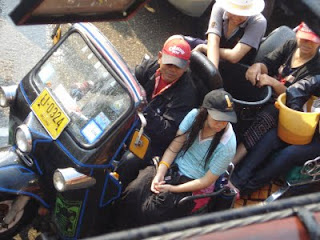 We spent our days wandering the moat road of the old city – the center of action due to the easy, albeit unhygienic water source - the muddy moat. The roads become packed with crawling trucks by 1 pm and stay so till 7 pm. The truck beds are filled with people dumping water on others from large plastic buckets and ceramic urns. Between the cars and trucks are motorbikes, also crawling, drivers half blinded by the water that is getting thrown on their heads and into their faces. People crowd the streets filling up the places between motor vehicles – men, women, young people, old people, monks. To walk one side of the moat took an hour on average, a distance that normally requires fifteen minutes max. Along the sides are stands selling food – most sopping wet, water fight casualties. Other stands sell water-guns: backpacks with squirters (hello kitty, Doremon, elephants), small hand guns, long range shooters, classic models of varying lengths. There are bands playing at intervals on raised platforms, some complete with foam machines. While there is supposedly a “no-alcohol” policy, beer is everywhere and crushed cans are used to prop up the hoods of all the cars to prevent over heating. The roads are flooded along the edge so that you end up walking in ankle deep moat water.
For some unknown reason many people feel the need to buy large blocks of ice to chill their ammunition. Traveling in a pack we devised a scoring system for those who shot us with bone-chilling water, covering each other by aiming at sensitive areas – 50 points for the mouth, 60 for the teeth, 75 for the ear and 100 for the eyes. Others stick to the moat as their source, which is pleasantly warm in comparison though has the minor downsides of probably being filled with diseases. At one point along the north-east side of the moat there is a stretch where you are never not being doused with a bucket. To prepare myself for the days I stuffed essentials in a waterproof pouch, filled my water guns, threw on a bathing suit, jean shorts and donned a yellow shirt that said in Thai “Chawp Len Nam” (I like to play in the water).

Perhaps what was most startling about the three-day holiday was that it was not startling. True there is nothing else like it that I have ever experienced and probably will ever experience, true I was wetter then I will ever be again, true I danced to Lady Gaga in the streets of Chiang Mai with strangers, doused monks with water and got thrown into a water cooler by friends from the climbing wall, but despite all this the entire experience did not feel not normal. Rather it felt decidedly normal. I had this thought specifically on the third day hemmed in by thousands of soaking Thai people completely clogging Huak Kaew road, dancing and screaming to Thai bands while being sprayed with nozzles of water from above. Oh Chiang Mai how I love you. What a way to welcome in the new year! Sawadee Bee Mai!
Wednesday, March 16, 2011
Offerings in the forest
When you fly up to my home city of Chiang Mai – on Thai Airways, Bangkok Air or Air Asia (I have flown them all) you can look out over the forests, plains, rice fields and see the land literally sparkle. Wats (or temples) are everywhere and everywhere they are covered in gold and mosaiced mirrors that catch the light and juggle it back and forth. When surrounded by the walls of some of the more elaborate wats in the midday heat, the effect is so powerful you must squint. From the air it is as if glitter was strewn across the landscape.
Out of the hundreds of Wats that dot Chiang Mai, my favorite is Wat Umong – the reclusive forest temple tucked behind Suthep road and the back gate of CMU. Along the walkways the trees are wrapped with orange – a sign that they are blessed and protected. And strung on many are green plaques bearing Buddhist wisdoms and proverbs. “Physical charms attract the eye. Goodness attracts the mind.” “The lures of love often lead to the grave.” “There is no preventing a fire from emitting smoke.” “The mad dog hates water, the sex crazy man hates dharma.”
The temple there is not the most grand, though there is a large stone, cloth-wrapped, Chedi. There is a small museum with murals on the walls and there are tunneled caves with nooks holding cross-legged Buddhas. There is a pond and an island reachable by a small metal bridge. Pigeons are particularly fond of the island, long nosed turtles too. There is a monastery and a nunnery.
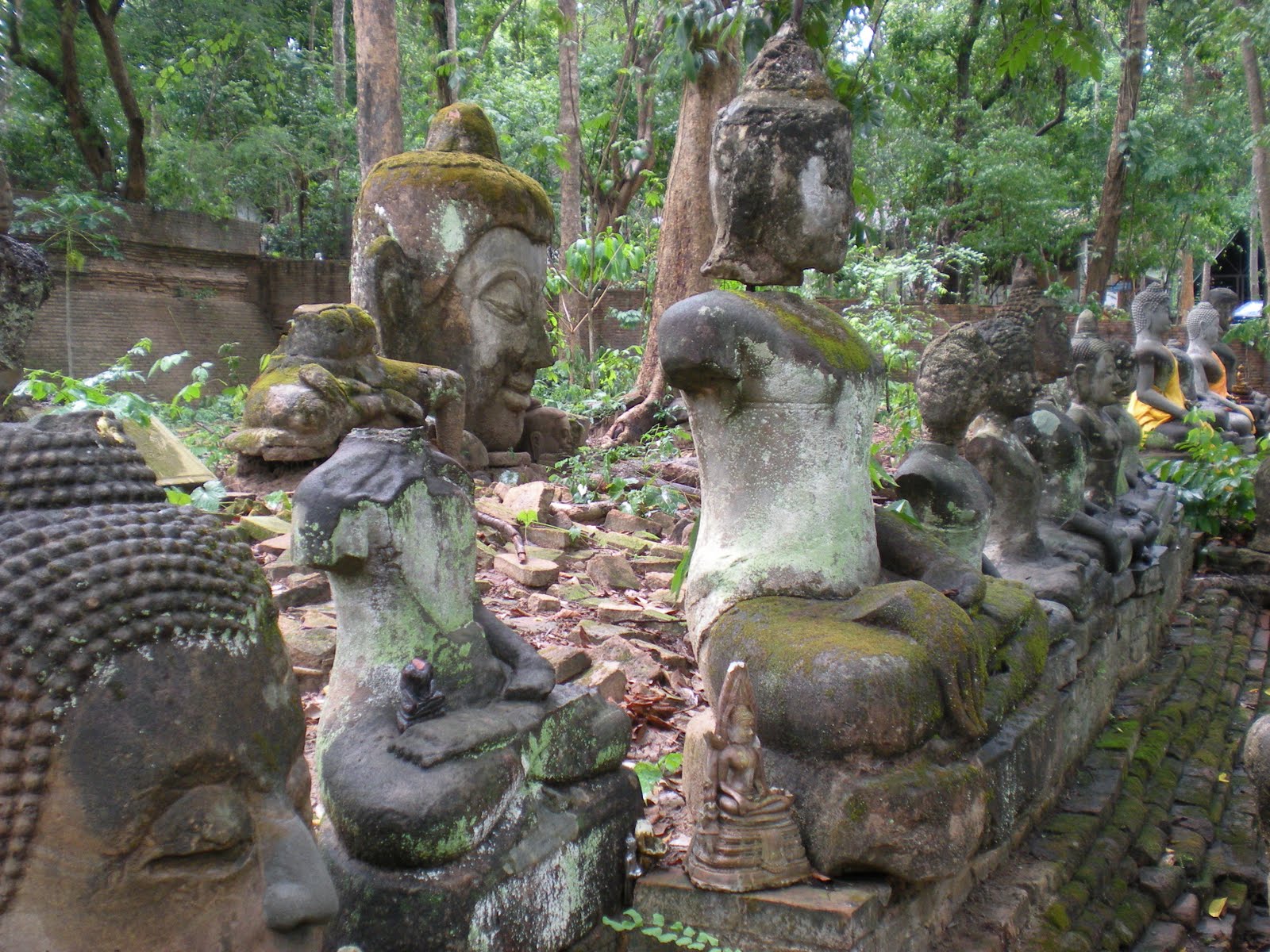
But my favorite place at Wat Umong is none of these. Rather it is a stretch of landscape running along the wall where there is a collection of Buddha heads and Buddha bodies. They sit crooked on a low rise wall with missing arms, heads, hands. One three-foot head sits cocked at an angle behind the others, pebbled hair covered with a veil of moss. One or two of the Buddhas are draped in yellow. Nearby is a raised circle that holds a collection of offerings – small plastic and metal Buddhas, horses, imposing men in high backed chairs, wooden elephants. They are in varying states – water and sun having worn away at paint and enamel. They are heaped, crooked and jumbled.
I come here to read, to study Thai, to eat bags of fresh cut fruit, to draw and to think. I have photographed this one spot in every season - hot, raining and cold. Out of all places it is the most peaceful in Chiang Mai.There is something about the place that is so full of life, despite the lack of distinction it holds compared the other sites in the temple complex. There is an acute presence and absence of people – all those who brought offerings for a milliard of reasons. The place is untidy, un-manicured, real - and for all this, enchantingly beautiful.


Monday, March 14, 2011
Wai-ing Michelin Men
My diet is almost entirely sustained by food sold on the streets. While we have grocery stores and convenience stores I rarely step inside their air-con interiors, but sometimes when bored I peruse the neon lit aisles for fun. In many ways the commercial landscape mirrors any you might find in a US city. True we have Tesco and Carrefour instead of Walmart, but you can find practically anything there all the same – hair products, tea brands, Skippy Peanut butter – as long as you know where to look and don’t mind paying extra. (I do, so I forgo these comforts of my former life on a regular basis). However most of those familiar brands and stores come with a Thai twist if you look closely. Starbucks sells Thai Ice Tea and McDonalds Thai Tea McFlurries along with Mango McFlurries.
Driving along the moat road of the Old City I often pass a garage selling Michelin tires. Outside they have propped up one of those life-size cardboard cutouts. He’s got the normal rippled dimensions of a man constructed out of tires, but his arms are not raised in a wave or stretched out in a muscular stride. Rather they come together at his chin in a Thai Wai (traditional bow).
A Thai 7-11 has all the usual trappings, but then you look closer and start realizing that you are not in Kansas anymore. Let's take as example Lays potato chips, which we have in abundance. We do have some of the common flavors: Cheese and Onion, Sour Cream and Onion, Salt and Sour, Barbeque, Extra Barbeque. Even Hot Chicken and Lemon is not too out of the ordinary. But Lays varieties do not stop there, indeed most of the shelf space is taken up by the following flavors: Sweet Basil, Spicy Seafood, Spicy Lobster, Nori Seaweed, Shrimp Tempura, Hot Chili Squid, and of course Pla Sam Rod (Fermented Fish). I have sampled almost all of these and can attest to the shocking realization of biting down on a crunchy, oily, familiar looking potato sliver expecting Extra Cheese and tasting Spicy Seafood instead. In such instances I’d rather forgo the semblance of the familiar altogether and head over to the nearest late night food stand for some grilled intestine– at least that way, I’ll be prepared for the taste.
Driving along the moat road of the Old City I often pass a garage selling Michelin tires. Outside they have propped up one of those life-size cardboard cutouts. He’s got the normal rippled dimensions of a man constructed out of tires, but his arms are not raised in a wave or stretched out in a muscular stride. Rather they come together at his chin in a Thai Wai (traditional bow).
A Thai 7-11 has all the usual trappings, but then you look closer and start realizing that you are not in Kansas anymore. Let's take as example Lays potato chips, which we have in abundance. We do have some of the common flavors: Cheese and Onion, Sour Cream and Onion, Salt and Sour, Barbeque, Extra Barbeque. Even Hot Chicken and Lemon is not too out of the ordinary. But Lays varieties do not stop there, indeed most of the shelf space is taken up by the following flavors: Sweet Basil, Spicy Seafood, Spicy Lobster, Nori Seaweed, Shrimp Tempura, Hot Chili Squid, and of course Pla Sam Rod (Fermented Fish). I have sampled almost all of these and can attest to the shocking realization of biting down on a crunchy, oily, familiar looking potato sliver expecting Extra Cheese and tasting Spicy Seafood instead. In such instances I’d rather forgo the semblance of the familiar altogether and head over to the nearest late night food stand for some grilled intestine– at least that way, I’ll be prepared for the taste.
Saturday, February 26, 2011
Raining Strawberries and Flowers

It seems that in the past weeks I have been attending increasing numbers of festivals. After sampling a wide range I can say with some authority that there are more similarities than differences between the differing celebrations. The venue and the occasion remain unique. The food stands however, do not. It is perhaps comforting to know that you will always find piles of noodles in varying widths that can be heaped with bean sprouts, peanuts and sugar. There are without question always stands frying tiny pink splayed sausages and others with vats bobbing with silky meatballs. There are also, the same variety of souvenir stands – Lana woven bags, frilled and bowed shirts, odd wooden plaques, and overlarge key-chains. It is as if the same vendors are on constant rotation between towns.
What changes is the theme, at least a few more stands of a particular item, or in some cases a profusion of one particular item. In Bo Sang it was Umbrellas, In Sappong it was Strawberries, in Chiang Mai it was flowers.
But my intention is not to dismiss festivals with a “seen one seen them all” attitude – though I might feel this at times. Instead I continue to seek out and happen upon festivals, specifically in search of the quirky idiosyncrasies.

 The Chiang Mai flower festival is not complete without a flower parade with massive floats composed of flower creatures, flower maps, flower temples, flower elephants, flower kings. There was even a bevy of Indian Princesses pulled in a fleet of rickshaws… I am still confused about their presence.

 And then there was one of those moments that I have had on a number of occasions where I am strikingly reminded that I am not in Cambridge anymore. Walking up the line of food stalls and souvenir stands, Lauren and I spied a dragon dance – an impressive many legged, electronically lit body that bobbed and swayed above the heads of the crowd. But terrestrial dancing and swerving were not enough so up it went, wrapping itself around a pole. All of this could have been viewed in a chinatown in the states, but this feat was still too tame for Chiang Mai. And so lets add fireworks into the dragon’s open mouth and set them alight so that they shower the gathered crowd below with sparks!

To offer an example – when TaReva and I drove out to Chiang Dao (72 km away from Chiang Mai) we found ourselves in the midst of a local Winter Festival with all the usual trappings and in addition: beauty pageants, fried toast on a stick and the most bizarre pet stand I have, and probably will ever see. It consisted of a wall of pastel colored cages each containing a miniature bunny that could fit into my palm. Not weird enough? Now put small baby doll clothes on all the bunnies.
In Sappong we perused a whole roadway of stands selling exactly the same strawberry products made by exactly the same company: dried strawberries, strawberry jam and locally produced, vinegar tasting strawberry wine.
The Chiang Mai flower festival is not complete without a flower parade with massive floats composed of flower creatures, flower maps, flower temples, flower elephants, flower kings. There was even a bevy of Indian Princesses pulled in a fleet of rickshaws… I am still confused about their presence. Then of course there was Chinese New Year that turned Wararot Market red and gold. There were more beauty pageants – this time with three year olds and there were lion dancers balancing on poles.
And then there was one of those moments that I have had on a number of occasions where I am strikingly reminded that I am not in Cambridge anymore. Walking up the line of food stalls and souvenir stands, Lauren and I spied a dragon dance – an impressive many legged, electronically lit body that bobbed and swayed above the heads of the crowd. But terrestrial dancing and swerving were not enough so up it went, wrapping itself around a pole. All of this could have been viewed in a chinatown in the states, but this feat was still too tame for Chiang Mai. And so lets add fireworks into the dragon’s open mouth and set them alight so that they shower the gathered crowd below with sparks!
Subscribe to:
Posts (Atom)